
© Arne Sattler
Welcome to the Official Website of Gerd Gigerenzer
Discover the work of Gerd Gigerenzer, a leading psychologist and internationally acclaimed expert in decision-making, risk literacy, and bounded rationality. With decades of groundbreaking research, Gerd Gigerenzer has reshaped how we understand human intuition, heuristics, and the ways people make decisions under uncertainty.
On this website, you will find an overview of his publications, current projects, and media appearances. Whether you're a researcher, policymaker, educator, or simply curious about the science of decision-making, this platform offers valuable insights into how we can make smarter, more informed choices in an increasingly complex world.
Gerd Gigerenzer, long-time director at the Max Planck Institute for Human Development, is currently director of the Harding Center for Risk Literacy at the University of Potsdam and vice-president of the European Research Council (ERC). He is former Professor of Psychology at the University of Chicago and John M. Olin Distinguished Visiting Professor, School of Law at the University of Virginia. Gigerenzer has received the American Association for the Advancement of Science (AAAS) award for the best journal article in the behavioral sciences, the German Psychology Prize, and the Communicator Prize. He has trained managers, doctors, and U.S. federal judges in dealing with risks and uncertainties. Switzerland’s prestigious Duttweiler Institute has named Gigerenzer one of the 100 most influential thinkers in the world. Read More
Explore. Learn. Decide.
Welcome to a world where intuition meets intelligence.
NEWS
NEWS
Upcoming Talks
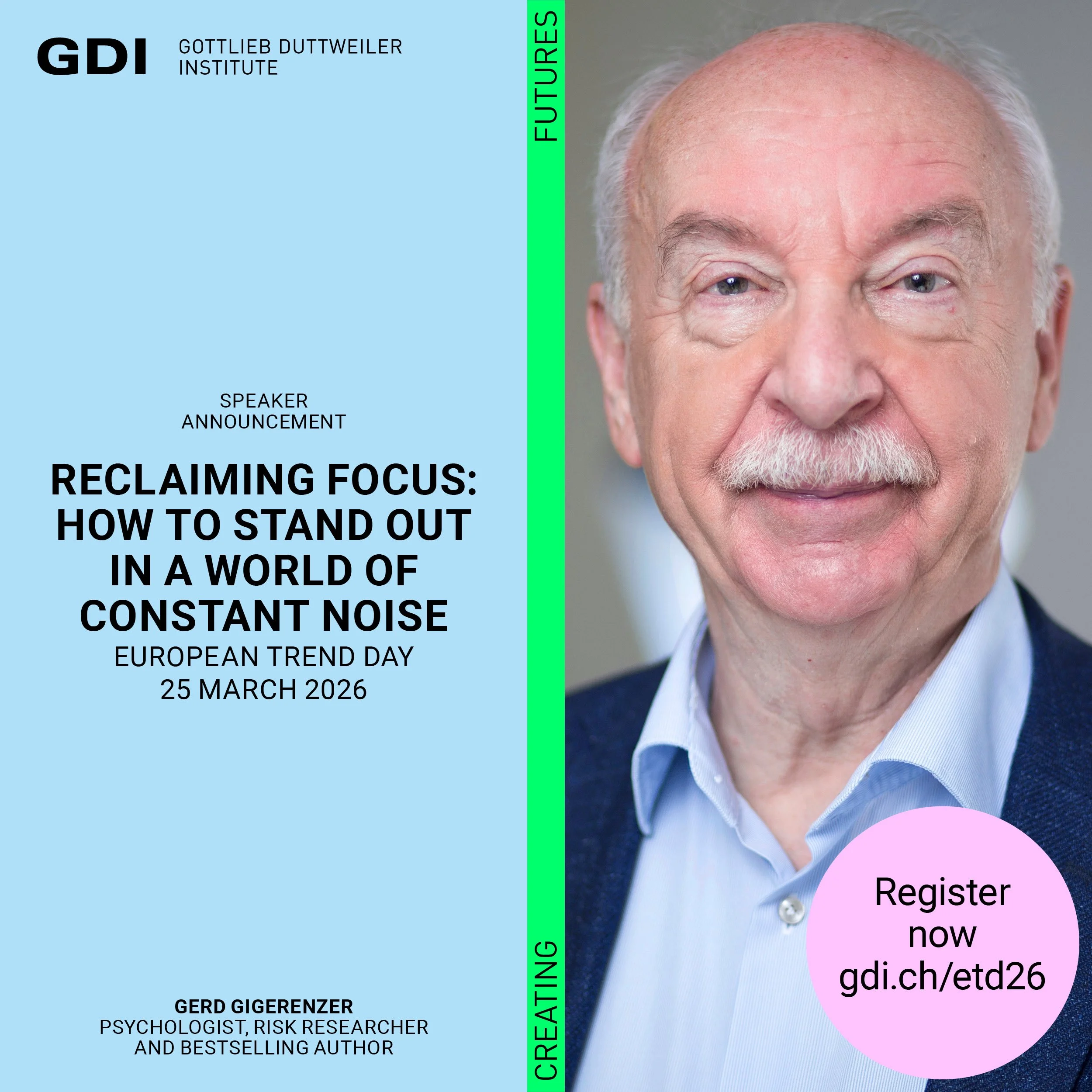
Reclaiming Focus: How to Stand Out in a World of Constant Noise
Intelligent systems are increasingly intruding into our everyday lives. Most of the time they go unnoticed, but they have a huge impact. They determine what we see, influence what we think about and manipulate our decisions. In the midst of the flood of digital services, the countless number of feeds and an ever-increasing volume of AI-generated content, many people lose their focus. Companies themselves fuel the flood of information and at the same time suffer from its impact, as messages get lost in the noise. Furthermore, democratic societies are struggling for control over the channels in which opinions are formed today. Attention becomes a scarce resource and distraction a constant companion. Learn More
GDI Gottlieb Duttweiler Institute
Langhaldenstrasse 21, 8803 Rüschlikon
Switzerland
+41 44 724 61 11
info@gdi.ch
Interesting News
New Publication: Fast-and-frugal heuristics: analytical models of intuition
Trust your gut. Do not rely on urges - analyze! Decisions are either logical or psychological … Such popular maxims reveal a complicated, even confused approach to how one should make decisions. The sciences of decision theory and practice suggest that managers should leverage the power of mathematics, whilst also reserving a role for personal insights. But how exactly can that be achieved? Read More (PDF)

Editorial - Making the digital world ours
Gerd Gigerenzer for ERC Magazine
Considering the digital world today means confronting questions that intersect with research, policy, and everyday life. As our societies become increasingly shaped by algorithms, platforms, and data-driven systems, the challenge is not just to keep up but to remain truly in control.
Exploring these questions, as my book How to Stay Smart in a Smart World does, reveals that while AI and automated systems excel at narrow, well-defined tasks, they often stumble when it comes to judgement, empathy, and uncertainty. Read More
The Erasmus Journal of Philosophy and Economics had invited me to write about the legacy of Kahneman.
The Legacy of Daniel Kahneman: A Personal View.
Daniel Kahneman and Amos Tversky’s joint papers from the 1970s and 1980s have inspired many, including myself. These articles magically turned statistical thinking—previously a niche interest—into a major research focus. Kahneman and Tversky revived the concept of heuristics, which had largely been forgotten at the time, and played a pivotal role in bringing psychology to the attention of economics and other social sciences. I was also deeply influenced by Tversky’s seminal work on the foundations of measurement, which inspired my first book on modeling (Gigerenzer 1981). Read More (PDF)
Reformation of science publishing: the Stockholm Declaration
One of the greatest threats to the integrity of science today is the exponentially increasing number of studies and data fabricated with the help of AI and published for commercial profit, which has become a lucrative industry. In June 2025, I was one of the invited participants in a workshop on the problem, held at the Royal Swedish Academy of Sciences in Stockholm. Our resulting statement and call to action (the Stockholm Declaration) can be found here:

New article: Two kinds of bias (Gigerenzer, 2025)
I distinguish two meanings of the term bias in the social sciences. In the first, biases are functional: they are necessary, and simultaneously enable and constrain perception and cognition. In the second, biases are viewed as errors and ideally should be reduced to zero. In the functional view, bias is value-neutral, neither good nor bad. This pragmatic perspective accepts that cognition must operate under conditions of uncertainty (rather than the certainty of a “small world”) and intractability (where the optimal solution cannot be calculated). Read More (PDF)
What is bias? And why are we biased?
Check out my talk from 7 November 2025, which I gave at the Paris Institute for Advanced Studies on “What is bias? And why are we biased?”